Wednesday, October 10, 2018

We Are "This Close" to Ending Polio: Thank You Rotary!


By T. R. Shaw Jr.
            If you’re a certain age, born in mid-20th Century, you might have heard of polio from your grandparents or maybe even know someone who suffered from the crippling childhood disease.
            If you were born in this century, it’s likely you’ve never heard of it.  Be grateful!
            Poliomyelitis (Polio) is a paralyzing and potentially fatal virus that plagued the 20th Century and still threatens children under five in some parts of the world.  It disabled Franklin D. Roosevelt and many other Americans of that era. 
The good news is, polio is about to become the second pandemic virus that has been eradicated from the face of the Earth.  In 1947, Dr. Jonas Salk, a physician who turned researcher and immunologist, developed a vaccine to prevent polio with the help of the Foundation for Infantile Paralysis.
Salk, was hailed a hero in 1955 when news of the vaccines’ success was made public.  Salk deemed it a “moral commitment” to immunize all children, and advocated an aggressive immunization campaign in the U.S. and around the world.  He refused to pursue personal profit and a patent for his discovery, believing public health was a greater concern.  When asked, he stated, “There is no patent…could you patent the Sun?”
Generations from the 1960’s on, grew up with vaccinations, and without the threat, or fear of polio.  Gone were leg braces, iron lungs, social embarrassment and isolation.  The disease became a relic of another era.  In a brief time, polio was eradicated in the United States thanks to Salk’s vaccine, aggressive administration, and his generosity with the cure.
Polio has continued to be pandemic in the rest of the world, especially in developing countries with little or no healthcare.  The problem is not a cure, but distribution and vaccination. 
This is where Rotary comes into the picture.
In 1985 Rotary International launched its Polio Plus program to rid the world of polio through mass vaccination of children.  From that time forward, Rotarians have traveled throughout the world sponsoring polio days and administering vaccinations to children in some of the most remote places on Earth.  It’s simply two drops on the tongue.  The battle was just getting it there. In some parts of the world, cease fires took place in Waring nations to allow citizens to get immunized.  Lines at some stations stretched for miles and it was common for women to carry their children 10 miles or more just to get to a vaccination.
Today, polio exists in only three nations on Earth; Afghanistan, Nigeria and Pakistan.  Only 22 cases were confirmed worldwide in 2017, a reduction of 99.9 percent since the 1980’s when the world saw more than 1,000 cases daily.  The remaining cases are the most difficult to prevent due to geographic isolation, poor pubic infrastructure, armed conflict and cultural barriers.  Until it is completely eradicated, all nations are still at risk.

Immunized children show off their
Purple Pinkies

The Global Polio Eradication Initiative, formed in 1988, is a public-private partnership which includes Rotary, The World Health Organization, U.S. Center for Disease Control, UNICEF, and the Bill and Melinda Gates Foundation.  Rotary’s focus is advocacy, fundraising, volunteer recruitment, administration and awareness.  Rotary has also contributed more than $1.8 billion raised by Rotarians in the 33,000 clubs worldwide.  Rotary’s Advocacy efforts have played a role in decisions by donor governments to contribute more than $7.2 billion to the eradication effort.
Rotary has had an ongoing “This Close” campaign with a growing roster of public figures helping to raise awareness, including Bill Gates, John Cena, Jackie Chan, Queen Noor, Bishop Desmond Tutu and Jack Nicklaus to name a few.  These ambassadors help educate the public about polio through public service announcements, social media and public appearances.
Rotary plans to recognize World Polio Day on October 24 to raise awareness of the organization’s efforts and make the final push towards total worldwide eradication.  Many Rotarians may have a “purple pinkie”, a purple fingernail which might raise curiosity.  The purple pinkie campaign reflects the fact that once a child has been immunized, their pinkie is dipped in purple ink as a way of marking their immunization.
Rotary is counting down to History and hopes to end this disease in the very near future.  We are “This Close” to that day!
If you would like to contribute to Rotary’s Polio Campaign, visit www.endpolio.org or www.rotary.org for more information.


T. R. Shaw Jr. is CEO of Shaw Communication in Battle Creek, a past president of the Cereal City Sunrise Rotary Club, and a Paul Harris Fellow.  He is also Public Image Chairman for Rotary’s District 6360 and is a contributor to Polio Plus.

Thursday, March 15, 2018

Is It Time To Retire The Term "Rust Belt?"


By T. R. Shaw Jr.

            My hometown of Battle Creek is getting some much appreciated attention lately.  The community has been featured in major business journals, national and international newspapers, and most recently a series of stories in Crains Michigan Business, and it’s not about cereal! 
           
However, in nearly every report, journalists couldn’t resist using the term “Rust Belt” when framing our region.  A term many of us scoff at from our past.

The recent accolades center on our community’s entrepreneurial efforts, and the growth of the Fort Custer Industrial Park, which in thirty years has attracted 70 firms from around the globe.   The Park is adjacent to Michigan’s third busiest airport with a 10,000 foot runway and lots of room to grow.

High tech companies supporting the automobile industry have occupied “The Fort” since 1974, employing more than 21,500 people.  Our biggest resident and employer is Denso Manufacturing, a Japanese owned company making heaters, air conditioners, and radiators for most of the auto industry and employing more than 2,100 associates (they don’t call them employees.)  Denso recently installed an impressive robotic line which didn’t replace any laborers. 

Battle Creek also landed lithium component manufacturer Toda USA which is making parts for the next generation of hybrid electric vehicles.  Toda recently inked a deal with BASF and will expand in the near future.  Oh, yes, Kellogg and Post are still here, but the community appears to have moved well beyond the “Cereal City” moniker.

Our economic development entity, Battle Creek Unlimited, which manages Fort Custer Industrial Park, formed in 1974 and took advantage of the former military base when it was officially closed by then Secretary of Defense Robert McNamara.  BCU recently cleared hundreds of acres, making them “infrastructure-ready” parcels, going well beyond “shovel ready,” and offering it to developers and corporations.  The interest in this land is overwhelming and will fill quickly; that’s very good for our region and state!  No Rust Belt mentality here!

Rust Belt is a term coined in the late 70’s and early 80’s during the worst part of the industrial decline.  Rust Belt refers to an economic region of the United States primarily in the formerly dominant industrial states of Illinois, Indiana, Michigan, Ohio, and Pennsylvania.   It came to symbolize a devastating economic change, primarily with the downsizing of the steel industry in towns like, Pittsburgh, Allentown and Youngstown.  The ripple of that economic decline has been felt throughout all the Midwest for thirty or more years, especially in Michigan where the automobile industry is dominant.

We have many “belts” in our nation, there is a snow belt, sun belt, corn belt, fruit belt and even a few Bible belts scattered throughout the nation.  Even our capital is situated within a “beltway.”  So the term Rust Belt was geographically fitting, for the decline of the steel industry and everything related to it during that era.  I question whether that term is still valid today with all the shifts and expansion in manufacturing and technology, which have replaced much of our hard industrial might?

In 1984 Scholars, Murray L. Weidenbaum and Michael J. Athey at Washington University in St. Louis, Center for the Study of American Business, addressed that topic in a point paper, The Revival of the Rust Belt.

In this study, they questioned if the term Rust Belt was then an anachronistic term with the coming changes in the Midwest.  They opined,

“The facts available to answer these questions are undramatic,
not supportive of any extreme position, and thus uncompetitive in
the marketplace for public policy viewpoints. The truth of the matter
is that some of this nation's heavy industry is no longer competitive
and is in the process of shrinking in size and importance;
steel and automobile companies have reported the most dramatic
cutbacks. Yet, on balance, the answer to each of the questions is a
clear "no."
If there is a "Rust Belt," it is far more a question of perception
than reality.”

            They went on to discuss how industry has been replaced by technology and the traditional labor jobs have given way to better ways and systems of doing things.  Basically, they denied that we truly have a “Rust Belt” under the current direction the region was moving. 

            If industrial giants of the past such as Andrew Carnegie and Harvey Firestone
were to visit their old companies, they would be pleasantly
surprised by the array of high technology now in use: industrial
robots, sophisticated process control, laser inspection, flexible
manufacturing systems (FMS), automated material handling,
and CAD/CAM (computer-aided design along with computer-aided
manufacturing).”

            These words were expressed in 1984 and still ring true today.  So my question is, why do we continue to accept and use the term Rust Belt, when so many great things are happening, especially here in Michigan?   Under Governor Jennifer Granholm, we created “Automation Alley,” in metro Detroit.   Under Governor Rick Snyder, we’ve come a long way in “reinventing” our state and how we do business.  Detroit is seeing unprecedented investment and growth around technology.  It’s the comeback city of the Midwest.  The auto industry stands on the brink of huge new advances with hybrid and electric cars.  For the first time in many years, companies are coming back to Michigan, rather than leaving to do business.

            True, we still have a long way to go economically, but we are far from the malaise of the so called Rust Belt era.   While many journalists and scholars still employ the term Rust Belt, I’d like to see that phrase used in historical perspective. 

            Yes, we may have been the Rust Belt, but that term really no longer fits the direction we are moving.  Too many good things are happening to be labeled with a term like that from the past.


            T. R. Shaw, Jr. is CEO of Shaw Communication in Battle Creek.  He is a freelance writer and aspiring author.

Sunday, January 28, 2018

Crisis Communication, Michigan State University, and the Changing Paradigm of Journalism


By T. R. Shaw Jr.
            The past few weeks have been a roller coaster for those of us in Michigan.  We are enduring Penn State II as the Nasser sexual abuse debacle has dominated both the local and national news, as it should.  This is far worse than what happened at Penn State and it’s not over yet.
            The epicenter of all this is East Lansing, Michigan, proud home to our nation’s first land grant college, Michigan State University.  Lately, the school has become less known for sports and more known for a stream of abused athletes, mostly female gymnasts, coming forth with gut-wrenching stories of abuse at the hands of a university sponsored doctor, Larry Nasser.
            At this point, this episode has brought down the university president, athletic director and a few high-ranking athletic representatives.  It has also forced the resignation of several members of the USA Gymnastics Board and a tsunami of further resignations is likely forthcoming.  Nasser has begun serving a 175 year sentence.
            While most of us know the story; many complaints were made against Nasser, none were taken seriously by MSU.  As an active campus police investigation took place, Nasser continued to work for both the school and USA Gymnastics for several years and months with latitude and impunity.  Through ignorance and indifference, young people’s voices were not being heard or taken seriously.  A major university and the Olympic movement were too big to fail; something like that cannot happen at this level many assumed.
            The case went public when a Olympic Gold Medal gymnast finally got her voice heard through a journalist at the Indianapolis Star.  Yes, the power of the press had to be applied in this situation to affect change.  After that, all Hell has broken loose and finally, some resolution came for many victims who were powerless and unheard.
            As a public relations practitioner and journalist, I’ve been quite amazed at how MSU has handled, or failed to handle this situation.  MSU is known to have an outstanding journalism program and has produced many top journalists and public relations practitioners. 

To their credit, the student newspaper last week wrote an outstanding editorial following the resignation of President Lou Ann Simon and laid out a brilliant case for the future of “their” school, which demanded responsibility and accountability.  The student journalists closest to this, put it all into perspective far better than anyone has yet.

So, why then did the university fail so miserably in crisis communication?  The comments which came out of the administration and the board as this unfolded were insensitive, condescending, and lacked any clear message that they were ahead of this situation, reassuring their stake holders this would be dealt with in a professional and through manner.   They failed in very basic crisis communication practices and are now suffering for it. 
A quote from the STATE NEWS editorial says it best:  “As the most well-known faces of our university, we expected you to acknowledge the horrors that happened, but instead, we were left disappointed and concerned for the future of the university you all claim to love…You sat at press conferences, unprepared to talk about the largest scandal currently facing college athletics.”
Honestly, I don’t know what kind of plan they had in place or worked from, but the perception was they were utterly unprepared to properly communicate effectively. While they cannot change what happened or didn’t happen, there could have been much better public response from the university.
Earlier, NPR sports contributor and author, John U. Bacon, who sat through the Penn State trials, commented that he was surprised this isn’t getting the national outrage Penn State received during the Jerry Sandusky era.  Bacon said what’s happening at Michigan State is hundred times worse, and he’s right.
Part of it may have been media fatigue from the endless Hollywood and celebrity scandals such as Weinstein, Rose, Lauer, Cosby, etc.  But, still that’s no excuse. 
Likewise, in this era of instant, 24-hour news and social media, the university could have handled it much better, especially with communication experts in their midst.
While this tragedy continues to unfold, it is a textbook case of poor media planning, wrong responses, and failure to send the right messages.  I’m encouraged this episode was brought to life by a journalist, especially in this era where most of the media are maligned as “fake news.” 
I’m encouraged by student journalists rising above the noise to take a strong and courageous stand through the power of the press, and the courage of 150 young women finding their voice.
The future of our nation is bright with young people of this caliber rising above the status quo and bureaucracy and using their collective voice to affect institutional change.
My hope is all other institutions and organizations take the lessons learned from this and become serious about a crisis communication plan.  There is much to be learned from a communication standpoint with this horrible event.  The world is moving too fast to not get it right the first time.

T. R. Shaw Jr. is CEO of Shaw Communication in Battle Creek, Michigan.  You can read his blog, The Reluctant R(L)eader at www.read-mor.blogspot.com       


Wednesday, November 29, 2017

Negativity v. Being Realistic; a Conundrum for our Times?

By T. R. Shaw Jr.


A while ago I got into a heated discussion with another community leader about the abysmal turnout in our recent municipal election.  Not one precinct in our city attained a 10 percent voter turnout on Election Day.
The discussion continued on about what’s wrong with our city, government, and the world in general.  I brought up apathy, our community’s lack of a positive self-image, and well-intended, yet fruitless attempts at urban improvement.  I also opined about our local and regional economic condition as a factor.  I went into a real “Debbie Downer” mode and someone piped up and said, “You need to stop being so negative!” 
I retorted with a quick, and condescending response, “I’m not being negative, I’m being realistic!”  The conversation soon faded and went off into another subject, but the exchange bothered me.
I thought about that comeback later where I do most of my deep thinking, in the shower!  As someone who has a tendency to overthink, I wondered if I was truly being negative, or I was being realistic?  I even pondered if it’s a good thing to be negative?
This might be a topic for a college philosophy course, but where is the line between critical thinking, dealing with reality, and downright negativity?  Have I crossed the negativity line? 
As the media dwells on the problems of the day; and there are many, are we seeing the glass as only half full these days?  With a constant stream of 24/7 bad news, have we lost our ability to see the positive in the great things around us?
True, we cannot correct problems if we don’t acknowledge and recognize them.  I’m reminded that many great people have risen to challenges, and have been motivated by negativity.  Sometimes the best way to motivate is to tell someone they can’t do something!
One of the classic stories of negative motivation is the founder of FedEx.  In college he came up with the idea for a new kind of shipping company.  He envisioned a new paradigm.  His dissertation and theory was swiftly and immediately dismissed by a business professor who claimed, “You’d never be able to compete with the Post Office!”  That motivated him to pursue it, and FedEx is a household word today.
The point I pondered is whether or not negative energy can be a catalyst for positive change.  In self-reflection, I’ve felt myself becoming negative at times and have to really stop and look for the good in many situations.  Is this a side effect of our world today?  Is this normal?  Are we seeing the negative first in too many situations before we stop and consciously look for the positive? 
Being negative is easy, it takes little or no effort.  We have to work hard at being positive most of the time, especially in today’s world that dwells on the negative. 
It’s been my experience in the military, business, and civic leadership that good leaders and managers can immediately see “what’s wrong” with something long before others can.  Does this make them negative people?  Not exactly.  If they are a good leader, they can see what’s wrong, but can also see the way to make it right or correct it.  Bad leaders will continue to dwell on what’s wrong. 
The exchange I had earlier, where I was chastised for being negative, caused me to rethink about how I view problems and start thinking about how to turn them into positives.
I’m in the process of writing a book about failure, perseverance, and success entitled “Defy the Immediate.”  It’s based on a term I learned in college.  Sometimes I forget my own lessons and forget to defy the negative emotions which surround us every day.  If we don’t look for the positive, we remain stuck in the negative. 
You cannot jump start a dead battery using only the negative terminal.  In today’s world we need to connect to the positive post as well.  There is enough negativity in the world without adding to it. 
Let’s start looking for the positive in a world gone negative. 
Let’s all start to “Defy the Immediate” in in the negative world around us.


T. R. Shaw Jr. is CEO of Shaw Communication in Battle Creek, Michigan.  He is a retired Navy Officer and funeral director and serves on many boards and civic organizations.  He is nearing completion of his first book, “Defy the Immediate” a motivational memoir.  Visit his blog, The Reluctant R(L)eader; www.read-mor.blogspot.com

Tuesday, October 31, 2017

Branding: Part of Professionalism


By T. R. Shaw Jr.
            I admit I’m a little old-fashioned and a bit of a traditionalist.  The world changes dramatically, almost on a daily, if not hourly basis.  Sometimes it takes a while to accept new and changing circumstances.
            I graduated from a great journalism school at Central Michigan University back in the days of land line phones, typewriters, carbon paper, and vario-typers.  We kept an eye on the Associated Press teletype in the corner of newsroom that constantly had to be fed paper.  Google some of that stuff, you might find it at the Smithsonian today.
Part of the journalism program involved outstanding training on photography and graphics which I have always enjoyed.  I’ve prided myself in the fact I have a keen sense of imagery and good graphics; hence my reluctance to change.
            For the past several years, I’ve been the PR guy for our Rotary Club; officially the Public Image Chairman.  Recently, I was selected to become the Public Image Chairman for the entire Rotary District, consisting of 62 clubs in Southwest Michigan.
            I quickly found that many clubs simply don’t embrace this Public Image stuff.  Many clubs, whose members are middle-aged and up, like me, have a hard time dealing with the social media cascade, and can’t understand why things have to change so much.  I admit, I’m basically self-taught with social media and still struggle from time to time with how it all connects.
            I recently attended a great Zone Training session in Chicago which brought together leaders from 26 Rotary Districts in the Upper Midwest.  The two Zones stretched from North Dakota through the Great Lakes and over into Pennsylvania and New York, almost reaching into New England.  Elbridge Gerry, the father of “Gerrymandering”, would be proud of our Zone map.
            I sat in with about 20 other PR people in the Public Image sessions.  Most of my colleagues had varying degrees of expertise in public affairs, social media and communication.
            I’ve been a journalist all my life, served as a Navy Public Affairs Officer, and thought I had a pretty good grasp of dealing with the media and the communication world today.  I felt like I was at least at the curve, and not behind it, when it came to today’s media trends.
            A few years ago, Rotary launched a new branding campaign which has taken almost six years to get on to the local club’s radar.  I’m guilty as anyone who didn’t immediately embrace the change in our imagery.  The classic Rotary Wheel and other emblems I felt were too good to tinker with and the new stuff just wasn’t appealing.
            I soon realized I became what Rotary was fighting against…resistance to change.  Too many different variations of Rotary’s classic trademark, the Rotary Wheel, were being used and diluting the brand.
Some of the old club logos which are no longer
appropriate for consistent branding
Until it was all explained to me, I resisted using the new imagery, because the old stuff was graphically better I thought.  Well, some of it might be, but I soon found that with an organization the size and scope of Rotary it’s imperative we have a consistent brand image.  Until it was laid out how many clubs, districts and zones were using variations of our imagery, I realized how important it was.  I was one of the old “fuddy-duddys” who insisted that “if it ain’t broke, don’t fix it.”
It took a huge gathering like this to see how none of us were in sync with our branding and imagery campaign, and to realize that our “brand” is worth being consistent in defining who we are. 
The biggest epiphany came to me when someone stated that “Consistency in branding is a sign of professionalism.  We must be consistent and professional in our branding and imagery if we want to attract professional people to our cause!”
Bingo!
The lights went on for me.  I am now working to change the paradigm in my club and district to be compliant with our branding campaign.
Some of the New Club Logos from Rotary's Branding Center which allows
Personalization, yet consistency
I’m sure this same dilemma occurs in many organizations and businesses when those “in the field” resist change. 
Lesson learned, change can only occur when those closest to it embrace it.  It has to take place at the lowest level in the organization to truly work.  Without realizing it, I was an impediment to change.
My Rotary Public Image mission is now clear, lead the change and compel people to realize it’s part of being a professional organization. 
Isn’t that what we all want to be a part of?


            T. R. Shaw Jr. is CEO of Shaw Communication in Battle Creek, Michigan.  He serves as Rotary District 6360 Public Image Chairman in Southwest Michigan.  You can read his blog, The Reluctant R(L)eader at www.read-mor.blogspot.com

Friday, October 6, 2017

College Football Needs to Return to Being College Football


By T. R. Shaw Jr.

            Perhaps I’m entering my “Grumpy Old Man” era, but I’m disappointed with the direction of college football.

            I grew up in a University of Michigan family.  My parents took many of my friends and me to Ann Arbor Saturdays where we witnessed the Ten Year War between Bo Schembechler and Woody Hayes.  We eagerly awaited Saturdays to see who Michigan was going to conquer next, enroute to that day in November when the forces of good and evil collided in the greatest rivalry in all of sports. 

Michigan and Ohio State was, and still is everything in college football.  The Victor typically won the Big Ten when there were still ten schools, and earned a trip to the Rose Bowl, the Granddaddy of them all!  Who cared about ranking!

I didn’t make it to Michigan, but I ended up at Central Michigan where I took the passion I learned for college football in Ann Arbor to Mount Pleasant.  I’ve been a loyal Chippewa season ticket holder and supporter since I graduated. I attend most of the games, as any loyal alumni should.

CMU’s Kelly-Shorts Stadium is no “Big House”, but it has provided many great “Central Saturdays” over the years, including last decade, under Brian Kelly and Butch Jones.  CMU produced superstars like Antonio Brown, Dan LeFevour, Joe Staley, and Eric Fisher the 2013 #1 Draft pick in all of college football, and most recently Cooper Rush, now a rookie quarterback with the Dallas Cowboys.   Chippewa Nation longs for another “Championship Culture.”

I still attend at least one of the games each season in Ann Arbor, as my sister inherited our family tickets and actually earned a Maize and Blue sheepskin.  Every game used to be reliably, a 1:00 Saturday date, etched in stone.  Then TV came and changed all that.

Today, game times aren’t even announced until a few days before, making it very difficult to plan ahead or invite friends.  Will it be a noon game? 3:00 game or possibly a night game?  This is a question the Michigan fans are asking, and for many their patience is growing thin.  At least the Wolverine faithful still have Saturday games.  Rarely, has there been a weeknight game in the Big Ten. 

The Mid-American Conference is now playing a lot of weeknight games.  I’m disappointed the marquee MAC game, Central Michigan versus Western Michigan, will be played on a Wednesday night in November!  College football has lost all respect for fans with weeknight games for TV.


A few years ago, the CMU-WMU game was played on a Tuesday night on ESPN2.  Then, it was the only college game in the nation that night, yet it played second-fiddle to ESPN which carried Poker.  I always thought that was rather insulting and a huge missed opportunity to showcase “real” college football.

The Athletic Directors and NCAA argue they make money on TV, but they are doing it with supposed “student-athletes” who have to skip classes, travel, and recover after weeknight games.  It makes no sense and the NCAA ought to be ashamed about what they are doing to these kids for the sake of “exposure.” 

It’s not just the players, the fans are also forgotten with these games.  Most of the midweek games have half-empty stadiums; few will travel great distances on a weeknight, they simply can’t.  Add to that, the constant “TV Time Outs” destroys the pace of the game and make these games 4-5 hours of torture for those who show up.  After several of these long pauses to pitch beer and car insurance, many fans around me once started yelling, “Just Play the Game Damn It!”  Night games sometimes end after midnight.  This also destroys some of the economic impact in the college town as everyone heads home after the game.

            My concern is that TV has so invaded the college atmosphere that we’ve lost the true essence of the game.  Back in the Bo and Woody era, you sat on the edge of your seat as you watched the crusade unfold.  You didn’t have the long breaks, things kept moving and you couldn’t take your eyes off it.  I’m concerned young fans will never have that experience, for some it’s become like watching a baseball game.

            I’m also concerned that many long and devoted alumni and fans will turn away from attending and supporting programs.  I’m hearing more and more say they will stay at home and watch the game, as all of them are now televised and they don’t have to deal with the hassle, expense, and uncertainty of game time.  Many cannot afford to take the kids and the neighbors to games anymore, like when I was growing up.  That’s a true shame!

            I sincerely hope the current fan rift in the NFL doesn’t spill over into college football.  Longtime fans are burning their tickets and jerseys and boycotting the games over the player and owner activism, right or wrong.  Add to that the massive amount of money in sneaker and uniform deals might finally get some scrutiny after the NCAA was “willfully ignorant” when the FBI began arresting basketball coaches.  You can bet that will affect football too!  More to come on that!

            Schembechler once said, “College football is a religion, and Saturday is the Holy Day of Obligation.”  The next few years will determine if the flock stays together; whether fans and alumni will continue to dump obscene amounts of money into licensing and tickets when the program and TV isn’t paying attention to the customer.  It’s a business plan that might have dire consequences down the road.  A generation may be lost and once loyal alumni are no longer willing to write the big checks.

            I still love college football and can’t think of a better place to be than in one of the great athletic cathedrals on a fall weekend, sitting in the sunshine.  The faithful will continue to come, so long as the message and sermon continues to inspire. 

College football needs to return to being college football and the rich traditions which made it the product we can’t get enough of.  Enough with late night and week night games!  Let’s make fall Saturday afternoons special again!

T. R. Shaw Jr., is CEO of Shaw Communication in Battle Creek, Michigan.  He blogs at:  The Reluctant R(L)eader at www.read-mor.blogspot.com


Monday, September 18, 2017

Hazing; A Barbaric Act with no place in Civilized Society


By T. R. Shaw, Jr.
            Once again the despicable act of hazing has claimed the life of another young, promising college student at a major university.  
            This time it happened at Louisiana State University to a pledge of Phi Delta Theta.  Last Spring another pledge’s life was brutally snuffed out in Beta Theta Pi at Penn State University where criminal charges are still being prosecuted.  These incidents are sickening, totally unacceptable, and absolutely indefensible.  They should never have happened.
            Hazing is defined as subjecting a subordinate to mental, physical and emotional abuse with acts of humiliation and violence which may lead to injury or death.
Full disclosure, I’m a Sigma Chi alumni and active with my chapter at Central Michigan University.  I serve on our House Corporation and Alumni Association Board, and mentor the active chapter.  These tragic incidents at major universities hit close to home for me.
            I can honestly admit I never experienced hazing in my fraternity experience.  I’m proud Sigma Chi has had a longstanding policy against hazing and proactively prohibits it.  It is discussed ad nauseum at our Leadership Training Workshops.  My fraternity, and I likely speak for all the others, takes a strong and unwavering stand against hazing, as it should be.  They would be foolish not to.  Hazing violates our core principles of Friendship, Justice, and Learning.

In college, we did the crazy things fraternities do, and there was certainly potential for situations which could be considered hazing, but we believed such acts do not create brotherhood, camaraderie or esprit de corps.  We never crossed that line.  We knew hazing was the quickest way to lose our charter and everything we hold dear. 
            During the time I was pledging, the Interfraternity Council at CMU hosted a lecture by Eileen Stevens, the mother of college student who died in 1978 in a hazing incident.  Her son, Chuck Stenzel, a freshman at Alfred University in New York, died in the trunk of a car from hypothermia and acute alcohol poisoning at the hands of a fraternity gone wild.  It was clearly a barbaric act of hazing.  Her crusade and organization, CHUCK (Committee to Halt Useless College Killings), was powerful and well received.  It was her personal crusade, and she shared her anti-hazing message at more than 700 colleges through the years.   We heard her message and anguish loud and clear.  All of us at CMU in those days were onboard with the fact that hazing was totally useless and unnecessary. 
            Since those days all fraternities have gone through periods of decline and rebuilding.  Our chapter at CMU nearly ended in the 90’s but made a strong come back in the new millennium.  From what I’ve witnessed, I’m confident the message against hazing has endured.  
            So why is hazing still happening?  I believe many fraternities lack strong and responsible alumni and adult oversight.  Frankly, it’s difficult to find good alumni willing to devote the time, energy and responsibility for ensuring the active chapter isn’t violating civil and fraternal laws.  It takes a special person to be a chapter advisor or alumni leader.  With the challenges of professional life and family, it’s a task many shun, and are unwilling to take on.
            We can’t deny the prevalence of alcohol, and to a lesser extent drug abuse, has on the local fraternity.  The median age of most fraternities is 19 and the drinking age in nearly every state is 21.  The pressure to fit in can be overwhelming to many young students; many cannot handle it.  Violating the law goes against the principles most fraternities profess and stand for, which is often forgotten in the heat of the moment. 
The fight to make fraternity houses “dry” is still vigorously opposed in most circumstances which is unfortunate.  Alcohol and binge drinking is destroying many young lives and creating future problems. 
Lately, with many fraternities, the individual school has taken stronger disciplinary action than the national organization when things go wrong.  Following the recent death at LSU, the school has shut down ALL Greek organizations.  I hope that’s a wake up call to every national office.  In many instances, if the national won’t take swift action, the school will.  We’re seeing this more often.  This is not what most national fraternities want.  Most want a strong relationship with schools.   Alumni need to reengage with their chapters.
I don’t know what the correct answer to all of this is.  Nobody wants to see more of this nor the media attention it brings.  Above all, nobody wants to see young people die tragically in foolish deaths.  I do know that all Greek letter organizations are on the hot seat at most institutions.  There is a movement to abolish them altogether, which would be unfortunate.  I can say with a great deal of perspective most fraternities and sororities are great institutions which produce people of character, teach positive life values, build leaders and contribute immensely to the college experience.  Greeks have been traditionally stereotyped, and when bad things happen they face the scorn of society.
Bottom line, hazing in all forms is abhorrent behavior which needs to be abolished by any organization which professes to build character, including fraternities, the military, sports teams, and any other organization dealing with young people.  Hazing is not limited to Greek life.  Hazing does nothing but divide and destroy organizations and individuals. 
The more we can do to fight this menace, the greater all of us will be.  When we truly respect each other, this would never happen.  I applaud all those who take a strong stand against this barbaric practice and hope it becomes a thing of the past. 
No parent should ever have to fear for their child’s life when they go off to college.

T. R. Shaw Jr. is CEO of Shaw Communication in Battle Creek, Michigan.  You can read his blog, The Reluctant R(L)eader at www.read-mor.blogspot.com     


Sunday, September 3, 2017

Feel the urge to Donate? Think about keeping it Local!

By T. R. Shaw Jr.

            For the past several days we’ve been deluged with images of the devastation in South Texas.  As relief efforts kick into high gear, the donations of money and material goods are flowing to that region.   It’s always heart-warming to see America’s true character rise when such catastrophe befalls our fellow citizens.


            Immediately following such events, Americans open their hearts and checkbooks in an effort to “do something.”  While many of us cannot physically go there and help, we have an urge to support relief efforts which is a great thing, by donating to any of hundreds of organizations.  Many are worthy, many are a waste of money, choose carefully when donating.

            If one feels the overwhelming urge to donate, I might suggest you “keep it local” and help those closer to home which will have a greater impact.  A recent report cited the fact that many heart-felt donations of money and especially goods go unused because of the overwhelming response in the moment. 

Following the massacre at Sandy Hook Elementary, New Town, Connecticut was flooded with more than 57,000 teddy bears and more school supplies than they could use in ten years.  In Indonesia, following the tsunami, mountains of donated clothing rotted and had to be burned.  After the earthquake in Haiti, thousands of pounds of donated food had to be destroyed before it could be safely consumed.  While we want to feel good about “doing something,” many of us have unknowingly created another disaster in logistics and distribution with our overwhelming generosity.

Following the devastation of the September 11, 2001 attack in New York, my Rotary Club, Cereal City Sunrise in Battle Creek, Michigan, debated what to do to help out.  We didn’t want to send money.  We thought about sending firemen’s boots because firemen working the recovery were going through them on a daily basis with the heat and jagged metal.  We surmised, if we did that, how would the boots get there and how would we know they reached the right people?  Do they really need them?

Our solution to our 9/11 dilemma became a local one.  We decided to establish a local scholarship fund at Kellogg Community College which supported any student pursuing law enforcement, firefighting or emergency medical services.  The college has an outstanding public safety program in each of these fields.  We figured a local 9/11 Public Safety Fund would last longer and have a greater impact than sending money or items to a faraway place.  Today, our club has helped dozens of students enter the public safety profession.  It was a long term solution to a short term need.  It is something our Rotary Club has been very proud of and continues to support today.

            My admonition to you is, if you feel compelled to give, please do.  But also look around you for needs closer to home.  While it is a great thing to help those devastated by a natural disaster, there are still plenty of needs in your hometown.  Sometimes it takes a large-scale disaster to ignite the fires of compassion, that’s human nature.  In these times we see the very best of people emerge, but let’s not create another logistical disaster when needs are great all around us.

            I’m reminded of the phrase, “Think Globally, Act Locally” is quite appropriate in this time in our nation. 

Above all, give whatever, and wherever you can, it’s the right thing to do.


T. R. Shaw Jr. is CEO and co-founder of Shaw Communication in Battle Creek.  You can read his blog, The Reluctant R(L)eader at www.read-mor.blogspot.com


Monday, August 14, 2017

Self-Driving Cars and Other Evil Schemes; Confessions of a Gear Head


 By T. R. Shaw Jr.

            Recently CBS’s Sunday Morning featured a segment on automation.  The segment covered everything from robotics at an Amazon warehouse, where everything is gathered, packed and shipped without human intervention, to the growing trend of driverless vehicles. 

While robotics has greatly improved our productivity in industry, it has created a smaller human workforce.  Many traditional manufacturing jobs have been eliminated as a robot can out-work a laborer in nearly every circumstance.  They don’t require time off, health care or maternity leave, they just simply do the job exceptionally well.

            While we’ve come to accept robots doing the menial, repetitive and time consuming tasks a large work force used to do, it’s the driverless cars and trucks that have me very concerned. 

Sunday Morning featured Otto, a self-driving 18 wheeler which recently transported a load of beer across Colorado with no human in the cab.  Sunday Morning did an interview in the cab of an autonomous truck where the driver, once on the highway, put it into autopilot and the driver became a passenger.  The company was experimenting with trucks that go automatic once on the freeway, but are driven by humans once they exit the freeway. 

The same experiments are going on with private cars which concerns me.  While some argue it will make traffic safer and more efficient, especially in big cities, I remain skeptical.  Some have said it will allow people to actually work in their cars on their daily commutes, not having to drive.  Face it, who really wants to do that?

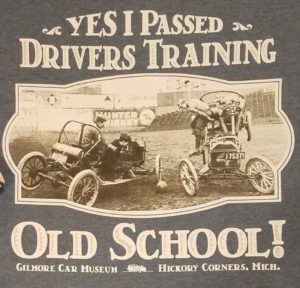
As a devout “Gear Head”, one who grew up with and deeply appreciates the automobile and the freedom it provides, I find it troubling people are eager to embrace riding around in an automated and perfunctory mode of transportation.

            The automobile is and always has been, America’s great freedom machine.  I find it troubling a generation is willing to give up the thrill and excitement of driving.

Growing up in Michigan, we have a strong, symbiotic bond with the auto industry.  America’s greatness and strength grew from the automobile.  The automobile created suburbia and gave people the means to live further from where they worked.  No other machine has more profoundly changed our culture.

 As kids, my generation couldn’t wait to drive.  Even the baby seat I sat in when we traveled had a steering wheel on it.  Most of us growing up in the 60’s and 70’s could still be shade-tree mechanics.  We knew a thing or two about carburetors, spark plugs, and torque and marveled at the big block engines and muscle cars until the environmental movement got into the act and forced regulations.

            I’ve been somewhat disappointed that many drivers today probably can’t find the dip stick, let alone actually check the oil.  When was the last time you actually saw someone check their oil at a gas station?   Many people today likely wouldn’t know how to jump start a car if they had to.

            It’s true that our cars have become extremely reliable today thanks to technology and innovation.  Rarely does anyone break down on the road anymore unless they’ve utterly neglected any form of maintenance.  We rely on our cars without much thought \ and usually don’t even think about something going wrong.  That in many ways is a good thing.

            But the thought of riding around in a car you are not controlling should be anathema to many of us who still get a thrill exploring the open road and knowing how and why your vehicle functions.  It’s in our DNA to explore what’s over the horizon and around the next curve.  Route 66 was created for the love of driving and discovery.  The thrill of the open road is a calling many of us still heed.  I hope that impulse never goes away.

          While technology marches on, many of us still covet the art and thrill of driving.   It’s in our blood and no amount of innovation can ever replace the feeling of being in command of your own vehicle and owning your destiny.

            Yep, I’m definitely a gear head!  And proud of it!


T. R. Shaw Jr. is CEO and co-founder of Shaw Communication in Battle Creek.  You can read his blog, The Reluctant R(L)eader at www.read-mor.blogspot.com